Ei Terasawa retires after 53 years of research and teaching
Ei Terasawa, professor of pediatrics in the UW–Madison School of Medicine and Public Health (SMPH), learned this August that she had earned emeritus status from the University of Wisconsin–Madison.
She may have 53 years at UW–Madison and the Wisconsin National Primate Research Center behind her, but she shows no signs of slowing down. Terasawa had just returned from Japan, where she gave a plenary lecture entitled “From historical insights to cutting edge advances in reproduction” at the 5th World Conference of Kisspeptin and International Congress of Neuroendocrinology in Nagoya, Japan. Following this trip, she received yet another invitation to give a talk at the 8th Global NEURO CONCLAVE meeting scheduled for Singapore in 2027.
Terasawa has been based at the Primate Center since moving from Japan to join then center director Robert Goy’s endocrinology lab as an associate scientist in 1973. She has since focused on investigating the mechanism of puberty onset in non-human primates as a model for humans. Terasawa also plans the center’s Robert Goy annual lecture series, soon entering its 12th year.
Here, we present more about Terasawa’s long career and discoveries in the SMPH Department of Pediatrics’ 2023 article Ei Terasawa Grilley marks 50 years as a scientist and teacher at the University of Wisconsin.
To follow are some words from a few of Terasawa’s colleagues.
Warm words
I knew that I wanted to conduct my graduate research with Ei after completing a rotation with her as a Neuroscience graduate student. I loved the project, and Ei was a brilliant (albeit demanding) mentor. She led by example and was the hardest-working and most dedicated scientist I have ever known. My training prepared me to move on and establish my own academic research program in neuroendocrinology. Outside of the lab, one of my favorite memories is what a generous and inclusive host Ei was. I particularly enjoyed eating her famous pickled beef, and enjoying the spectacular original paintings by her husband, including many pictures of Ei and their daughter.
— Andrea Gore, Ph.D., professor and Vacek Distinguished University Chair in Pharmacology, The University of Texas at Austin. Editor-in-Chief of Endocrinology, the official journal of Endocrine Society since 1917. Gore was a graduate student in the UW–Madison Neuroscience Graduate Training Program (1985-1990) and Terasawa was her thesis advisor.
Ei has been an inspirational figure for me since before I met her. Having taken a circuitous route to becoming a graduate student by attending the US Air Force Academy, then spending five years after graduation as an aircraft maintenance officer, and then applying to graduate school from Germany without being able to interview, I will always be grateful that Ei took a chance on me. Ei’s style of mentoring is to lead by example. She critically evaluated all hypotheses, including her own. She knew the literature backwards and forwards and taught me that knowing how much credence to give any one study was as important as the findings themselves. She had enormous expectations of herself as well as of her associates, and she treated others with a courteous respect that struck me then and has always stuck with me. I can only wish the very best for Ei in her next chapter.
— Michael D. Loose, Ph.D., emeritus professor of neuroscience, Oberlin College, OH. Loose was a graduate student in the UW–Madison Neuroscience Training Program and Terasawa was his thesis advisor.
It has been a true privilege and pleasure to work with Ei. Her extraordinary depth of knowledge of hypothalamic circuitry, and particularly the complex interplay among kisspeptin, neurokinin B, and dynorphin, has been a constant source of insight and inspiration. I have learned so much from her—not only about the nuances of these signaling pathways, but also about the fascinating ways in which their actions differ between males and females. Ei’s scientific rigor, curiosity, and generosity in sharing her knowledge have enriched both my own thinking and the field of reproductive neuroendocrinology.
— Stephanie Beth Seminara, M.D., professor of medicine, Massachusetts General Hospital at Harvard University. Seminara and Terasawa were co-principal investigators on a long-running NIH grant until Terasawa’s retirement. Jon Levine, Ph.D., succeeds Terasawa as a co-investigator on the grant.
Ei is an outstanding colleague and cherished long-time friend. She is a giant in the field of neuroendocrinology and will be sorely missed. Since my first postdoc at the Primate Center in 1979, I have been amazingly lucky to have enjoyed Ei’s immense intellect and understanding. Ei has exceptionally high expectations for herself, her trainees at every level, and her surrounding colleagues! She keeps you on your toes and you come to realize that it comes from a never ceasing desire for you to always be the best that you can be. That unselfish commitment to others is all too scarce in today’s world. Not surprisingly then, I soon realized that Ei has a heart of gold and envelopes her trainees and surrounding colleagues with her generous hospitality. She made sure no-one in her sphere was alone at holiday times. I have many fond memories of multiple potluck dinners and parties at Ei’s house, our young boys loving all the artwork and music that were important parts of Ei’s life outside science. I wish Ei a long and happy retirement spent with her daughter and grandchildren and all her friends. She deserves it.
— Dave Abbott, Ph.D., honorary professor of obstetrics and gynecology, UW–Madison School of Medicine and Public Health, UW Endocrinology & Reproductive Physiology Program.
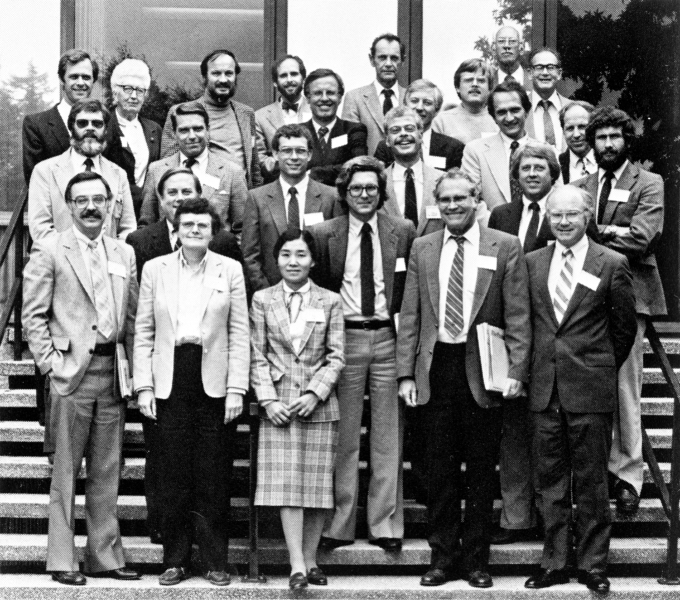
Role model, superstar researcher, professional colleague, scientific collaborator, and most importantly, close friend – these are the many dimensions of my decades-long relationship with Dr. Ei Terasawa, which stretches back to 1983 when I met her at a scientific symposium at the Oregon Regional Primate Research Center (see her in the front row, middle, below). As one of only three women of prominence at that meeting, this diminutive, soft-spoken scientist revealed herself as a powerhouse researcher who jumped right into the scientific fray at that time and provided the data set that set all of the male blowhards at the meeting straight. Over the coming decades, she and I became fast friends, working in parallel on primate and rodent models of female reproductive neuroendocrine systems, respectively. Ei’s intellect, creativity, incredible work ethic, and technical wizardry enabled her to complete a career in which she basically “wrote the book” on the neuroendocrine mechanisms that control puberty and menstrual cyclicity in primates. From my perspective as a late comer to the directorship of the WNPRC (2010), I have also been able to appreciate Ei’s wonderful commitment to the scientific and academic life of our beloved center, establishing working group seminars and the Robert Goy Lectureship, among many other contributions. It is hard to imagine the WNPRC without the scientific energy and devotion that Ei has brought to the center. Thank you, Ei!
— Jon E. Levine, Ph.D., professor of neuroscience, UW–Madison School of Medicine and Public Health, Primate Center director 2010-2025.