Golden Snub-nosed monkey
Table of contents
Evolution & ecology

Life span: >23 years (captive)
Total population: 8,000 to 20,000
Regions: Central China
Gestation: 6 months
Height: 58.2 to 68 cm (M), 47.5 to 51.8 cm (F)
Weight: 19.8 kg (M), 12.4 kg (F)
Conservation status: please search the IUCN Red List.
The golden monkey’s (Rhinopithecus roxellana) body and limbs are yellowish-red ranging from somewhat more brown to more brightly orange-red (Groves 2001). The back and dorsal surfaces have some black or dark brown, which extends down the extremities as a stripe and more solidly down the tail (Brandon-Jones 1985; Groves 2001). The back of the thighs is white and ventral surfaces of the body are yellowish-white or white-orange (Groves 1970; Brandon-Jones 1985, Groves 2001). Pelage is dark on the crown and upper back (Brandon-Jones 1985, Groves 2001). Males are brighter in color than other age and sex classes and as their age increases, the amount of orange in the coat increases (Brandon-Jones 1985). The muzzle is white and hairless and the area around the eyes is pale blue (Brandon-Jones 1985; Groves 2001). The body hair is long, usually ranging between 5 and 8 cm (2.0 and 3.1 in) and is interspersed with longer yellow hairs ranging from 12-16 cm (4.7-6.3 in) long (Groves 1970). Longer golden back hairs in adult males start growing after about six years old and can be up to 55 cm (21.7 in) long (Liang et al. 2000). The nostrils on the characteristic nose point directly forward and at the corners of the mouth, adult males have a wart-like growth (Groves 2001). This wart-like growth is the sole example of such a feature among the primates. Other members of the genus Rhinopithecus do not possess such a growth, nor do females of the species. The function of these growths has not been studied (Liang et al. 2000). The male genitals are bright, with a black penis and a blue-white scrotum (Davison 1982).
Head and body length averages 68.0 cm (26.8 in) in R. r. roxellana males and 51.8 cm (20.4 in) in females. R. r. qinlingensis males average 58.2 cm (22.9 in) and females average 48.4 cm (19.1 in). R. r. hubeiensis males average 67.4 cm (26.5 in) and females average 47.5 cm (18.7 in). The tail can range from about the same as the head and body length in R. r. roxellana, to longer than the head and body in R. r. hubeiensis (Wang et al. 1998). Actual body weight in males averages 17.9 kg (39.5 lb) and females average 11.6 kg (25.6 lb), however because of extreme variance and other factors, body weight estimates are considered somewhat more reliable than actual specimen weights. These estimates place average females at 12.4 kg (27.3 lb) and males at 19.8 kg (43.7 lb) (Jablonski & Pan 1995). In addition, there may be significant weight fluctuations with the seasons as well as between populations and habitats (Long Yong-Cheng pers. comm. cited in Jablonski & Pan 1995; Jablonski & Pan 1995). Either way, the species is sexually dimorphic based on body weight and size and adult males are larger than adult females (Jablonski & Pan 1995; Liang et al. 2001; Yi 2007).
In addition to pelage and body morphology differences, the subspecies are differentiated by differences in their nasal bones, pre-maxillae, and braincases (Wang et al. 1998). R. r. roxellana is characterized by its dull golden-red pelage with black-brown shoulders, and limbs (Wang et al. 1998). R. r. hubeiensis is distinguished by a longer tail than the other subspecies of golden snub-nosed monkey, up to 125% of the head and body length. Of the golden snub-nosed monkeys, it is the palest in pelage (Wang et al. 1998). R. r. qinlingensis is differentiated from the other subspecies by its brilliant golden pelage (Wang et al. 1998).
Wild golden snub-nosed monkeys can be very arboreal, spending 97.1% of their time in trees, mainly using the middle and upper strata of the forest (Yi 2007). However, in captivity and in other wild studies, the species spends more time on the ground and might be best described as semi-arboreal (Davison 1982; Su et al. 1998). In the wild, arboreal locomotion consists of large amounts of quadrupedal walking, climbing and leaping (Pan & Jablonski 1993; Su & Jablonski 1998; Su et al. 1998). Locomotion is 43% quadrupedal, 33% leaping and jumping, and 24% brachiation (Agetsuma et al. 1994). In addition, leaping with the forearms extended is used to move between trees and rarely, arm-swinging is used (Su et al. 1998). In captivity, types of arboreal locomotion consist of walking along horizontal supports, modified brachiation, vertical climbing and leaping and noisy display rushes. Travel on the ground in captivity includes quadrupedal walking, trotting and bounding, and occasional bipedal steps (Davison 1982).
In captivity, golden snub-nosed monkeys have lived past 23 years of age (Weigl 2005).
Range
Current range maps (IUCN Red List):
Rhinopithecus roxellana. The forests in central China (Kirkpatrick et al. 1999). Generally speaking, the species is found in the Sichuan, Gansu, Hubei and Shaanxi provinces around the edges of the Sichuan Basin. However, within this range, habitats are often separated and the distribution is not contiguous. The R. r. roxellana range is restricted to the western parts of the Sichuan province and the southern parts of the Gansu province between the Dadu River and the Sichuan Basin. R. r. qinlingensis ranges only in the southern Shaanxi province in the southern Qinling Mountains. R. r. hubeiensis ranges in the western Hubei and southeastern Sichuan provinces. It is restricted to areas within and around the Shennongjia forest region (Wang et al. 1998). The presence of golden snub-nosed monkeys in India near the Chinese border has long been debated and appears supported only by anecdotal evidence (see Gee 1952; Groves 1970; Roonwal & Mohnot 1977; Das-Chaudhuri 1991; Srinivasulu & Nagulu 2001).
Almost all systematic research on the golden snub-nosed monkey has taken place in the Shennongjia Nature Reserve and at the Baihe Nature Reserve, in the Hubei and Sichuan Provinces respectively (Kirkpatrick et al. 1999).
Total estimated population worldwide of R. roxellana and subspecies is estimated between 8,000 and 10,000 individuals (Ren et al. 1996/1997). Other estimates however, extrapolating from known population numbers in particular areas, place the total number somewhat higher, at roughly 20,000 individuals (Zhang et al. 2002).
Habitat
Golden snub-nosed monkeys inhabit mountainous temperate forests consisting of a mix of evergreen conifer and deciduous broadleaf trees in central China (Kirkpatrick et al. 1999). The species also uses a significant number of dead trees within their habitats as these are better hosts for food lichens than live trees (Li 2006). While the species will use secondary forest and shrub forest, they prefer primary forest (Li et al. 2002b; Li 2004). The altitude of their habitat ranges from 1200 to 3300 meters and is often topographically rugged (Gao & Liu 1995; Kirkpatrick 1995; Li 2007). Moving from lower altitudes to higher, the forest grades from predominantly deciduous broadleaf, to a mix of deciduous broadleaf and coniferous, to predominantly coniferous forest (Li et al.1994 cited in Li et al 2000; Li et al. 1995 cited in Li et al. 2000; Li et al. 2000). In general, the higher the elevation, the more coniferous trees predominate in the golden snub-nosed monkey habitats (Li 2007). Towards the higher altitudes of its habitat, it is found in sub-alpine conifer forests (Gao & Liu 1995).
Winter snow occurs often and cover can be long lasting, with the monkeys having to forage in snow cover for up to four months (usually stable cover from December to March) while withstanding the coldest average temperatures of any non-human primate in the world (Kirkpatrick et al. 1999; Li 2002; Li 2006; Li 2007). Because of the climatic seasonality of their habitat, their diet varies as well based on food availability. Lichens and bark are available year-round while buds, leaves, flowers, fruits, and seeds are only seasonally available (Li 2006). Within their habitat, golden snub-nosed monkeys mainly use the middle and upper forest strata (Li 2007).
In habitats on the southern slope of the Qinling Mountains in the Shaanxi province, the temperature can range from lows of -4 to 1°C (24.8 to 33.8°F) in the winter during January to 20 to 24°C (68 to 75.2 °F) in the summer in July with an average of 12°C (53.6°F) (Gao & Liu 1995). On the northern slope of the mountains, temperatures are different, with a mean annual temperature of 6.4°C (43.5°F) reaching as low as -8.3°C (17.1°F) in January and as high as 21.7°C (71.1°F) in July. Annual average rainfall at this study site is 98.0 cm (38.6 in). Winters are long and summers are short and the area is free of frost for less than half of the year (Gao & Liu 1995; Li et al. 2000).
At the Shennongjia Nature Reserve in Hubei province, the climate is highly seasonal with a rainy, moderate temperature spring (April to May), warm summer (June to mid-August), autumn (mid-August to October), and snowy winter (November-March) (Li 2002; Li 2006). July temperatures at this study site average 17.8°C (64.0°F) and January temperatures average -2.8°C (27.0°F). Rainfall here averages 180.0 cm (70.9 in) (Li 2006).
Ecology
Golden snub-nosed monkeys are primarily diurnal herbivores, consuming mainly lichens followed by other types of plant foods including trees, shrubs and vines as well as insects (Su et al. 1998; Li 2001; 2006). Due to their reliance on lichens, dead trees are often preferred as they host more lichens than live trees. On an annual basis, lichens of the family Usneaceae account for 43.28% of feeding, followed by young leaves (28.71%), fruits or seeds (14.57%), buds (5.36%), mature leaves (3.51%), herbs (2.09%), bark (1.36%) and flowers (1.13%) (Li 2006). Feeding primarily occurs in the middle and upper strata as these are the locations of the majority of its foods, however the monkeys eat bark from the low and middle strata and herbs and grasses on the ground (Kirkpatrick 1998; Li 2007).
Adult males spend more time on the ground than any of the other ages or sexes. Overall, the day is spent on the ground (15.3%), in the lower strata (24.3%), in the middle strata (28.2%) and in the canopy (32.2%) (Ren et al. 2001). In general, the predominantly arboreal nature of the species is due to the location of food resources and plant types as well as the risk of predation (Li 2007). Preferred trees include Connus controversa, Cerasus discadenia, Salix willichiana, Malus halliana, Abies fargesii, and Pinus armandii (Li et al. 2002b; Li 2006).
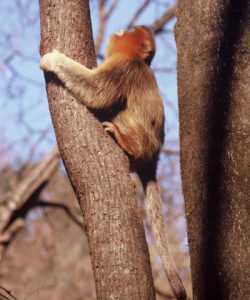
Photo: Cyril Grueter
The availability of foods and consumption by the golden snub-nosed monkey changes considerably between the seasons (Li 2006). Lichens are available year-round while other foods such as leaves, flowers, fruits and seeds are only present over various periods between April and November. Thus, not surprisingly, lichens are eaten more in winter than in the rest of the year and are a winter staple along with bark, insects and seeds (Su et al. 1998; Li 2001; Li et al. 2002b; Li 2006). In some habitats, lichens are not widely available in winter, resulting in the species relying more on bark in the winter (W.S.Pan, pers. comm. cited in Kirkpatrick 1998). Over the course of the year, diet consists of mostly lichens (Nov-Apr), leaves and lichens (May-July), and fruits, seeds, and lichens (Aug-Oct) (Li 2006). Bryophytes are consumed only in the summer and autumn (Kirkpatrick 1998). The species has been observed eating snow in the winter (Su et al. 1998).
In general, the day is broken up into two halves, with a rest period at noon and travel peaks in both the morning and afternoon (Li 2002). After each of the two travel peaks, more or less sedentary feeding is observed (Ren et al. 2000).
The home range of the golden snub-nosed monkey is quite large, with estimates and observations placing the value between 18.3 and 40 sq. km (7.1 and 15.4 sq. mi) (Su et al. 1998; Li et al. 2000; Ren et al. 2000; Tan et al. 2007). Home ranges of different groups can overlap (Ren et al. 2000). Within the home range, there is a core area of use which is considerably smaller, in one study averaging around 7.4 sq. km (2.9 sq. mi) (Tan et al. 2007). Daily path is variable with the seasons and between study sites, ranging from 100 to 5000 m (328.1 to 16,404.2 ft), with average daily distances ranging between 710 to 2100 m (2329.4 to 6889.8 ft) (Agetsuma et al. 1994; Su et al. 1998; Ren et al. 2000; Li 2002; Tan et al. 2007). Daily path is shorter during the winter than during other times of the year (Li 2002; Tan et al. 2007).
Goshawks (Accipiter gentilis) have been seen attacking a juvenile golden snub-nosed monkey and are predators of the species (Zhang et al. 1999b). Other potential and actual predators include the red dog (Cuon alpinus), wolf (Canis lupus), Asiatic golden cat (Catopuma temmincki), leopard (Panthera pardus), fox, zibet (Viverra zibetha), tiger (Panthera tigris amoyensis), weasel (Martes sp.) and the golden eagle (Aquila chrysaetos) (Happel & Cheek 1987; Su et al. 1998; Hu 1998 cited in Li et al. 2002b; Li 2007). A wolf was observed attacking a golden monkey group and fighting an adult male which subsequently died of its injuries (Renmei Ren pers. comm.).
Potential food competitors include the giant panda (Ailuropoda melanoleuca) and the takin (Budorcas taxicolor). In addition, the golden snub-nosed monkey may compete for food with the sympatric stump-tailed macaque Macaca arctoides (Happel & Cheek 1987).
Behavior & sociality
Social organization and behavior
Golden snub-nosed monkeys are usually considered to have two tiers of social organization with smaller social groups almost always conglomerating into well-organized larger troops, which can contain up to several hundred individuals and as many as 600 (Hu et al. 1980 cited in Kirkpatrick et al. 1999; Poirier & Hu 1983; Kirkpatrick 1995; Ren et al. 1998; Kirkpatrick et al. 1999; Ren et al. 2000; Zhang et al. 2006; Tan et al 2007). Some researchers, however, divide golden snub-nosed monkey social organization into three tiers; the basic social units, several basic social units organized into bands, and several bands organized into large troops while others place organization at just two levels, the smaller unit and the larger troop composed of the smaller units (Ren et al. 2000; Su et al. 2002; Tan et al. 2003).

Such aggregations of smaller social units into troops seasonally fluctuate, breaking up and aggregating at different times of the year, possibly due to human disturbance, thermoregulation, movement in snow, and availability of food items (Kirkpatrick 1995). Some researchers suggest that there is a fission-fusion social system within the troop while other researchers suggest that troops are stable and do not fluctuate in size (Ren et al. 2000; Tan et al. 2003). The basic social groups are of two types, the multi-female one-male unit (OMU) (possibly the primary social unit) and the all-male unit (AMU) (Ren et al. 1998; Ren et al. 2000; Zhang et al. 2006; Tan et al. 2007). OMUs average 9-18 individuals while all-male units average 4-7 individuals (Ren et al. 1998; Ren et al. 2000; Zhang et al. 2006). OMUs usually have stable membership and consist of several females, one male, and immature individuals (Poirier & Hu 1983; Kirkpatrick et al. 1999; Ren et al. 2000; Zhang et al. 2006). The male is the highest-ranking monkey in the OMU, with females ranking second after the adult male, occupying an unstable hierarchy amongst themselves. Sub-adult and juvenile individuals occupy the lowest ranks within the OMU (Li et al. 2006). Within a larger troop, one-male units have a hierarchical organization, with some units dominant to others (Zhang et al. 2003; Li et al. 2006). In addition, OMUs normally have one adult male but it is possible to have more than one (Ren et al. 2000; Zhang et al. 2006).
AMUs can contain 3-6 males but are not present in all instances (Kirkpatrick et al. 1999; Ren et al. 2000; see Wang et al. 2004). At one study site, the large troop consisted of adult males (10.5%), adult females (29.7%), sub-adult males (6.9%), adolescents (26.3%), juveniles (12.5%) and infants (14%) (Ren et al. 2000). When the troop is at rest or feeding, juveniles and infants will aggregate into groups that can be larger than 40 individuals (Ren et al. 1998). Homosexual mounting during play occurs between juvenile males and might function in social bonding (Lu et al. 2007).
When moving as a group, males buffer both ends of the troop with OMUs at the middle. As such, males act as a vanguard and rearguard for the group while traveling (Yan et al. 1995; Ren et al. 1998; Ren et al. 2000). The pattern is similar during foraging with males distributed at the front, center, and back of the troop with both females and infants more towards the center of the troop. Sub-adult males are mostly found at the center and back of the troop (Zhang et al. 1999c). When a threat is perceived in the environment, dozens of group males will aggregate, display, and vocalize in the direction of the threat (Ren et al. 2000).
There is a dominance hierarchy among both males and females in a smaller social unit (Ren et al. 1990b; 2000; Tan et al. 2003). Within an OMU the male and females won’t interact aggressively but adult females will fight with one another, with sub-adults, and with the young (Ren et al. 2000). In addition, in conflicts between females, males will intervene and help to pacify the females (Ren et al. 1991). In captivity, females within a unit can be dominant to the male (Ren et al. 1990b cited in Ren et al. 2000).
Grooming most often occurs within the same unit (92.4%) and only rarely with individuals in other units in the troop (Zhang et al. 2006). More intense and faster grooming is used to reconcile after a conflict (Ren et al. 2000). All grooming frequencies are influenced by social ranking and the primary motivation for grooming is hygiene (Li et al. 2002b).
In captivity, types of aggression include threats, chases, hitting, and biting. Post-conflict interactions include open mouth, rapid grooming, embrace and crouching behaviors (Ren et al. 1991). In the wild, males often aggressively interact with one another and generally do not accept the presence of other males when near females (R.M.Ren pers. comm. cited in Grüter & Zinner 2004; Grüter & Zinner 2004). Takeover of a OMU occurs when either a single male or the members of an AMU invade and oust the resident male using threats, displays, fighting and chasing; the outcome of which is possibly at least partially due to female preference (Guo pers. comm. cited in Wang et al. 2004; Wang et al. 2004). In addition, aggression between OMUs is quite common and occurs on average of 11 times per day (Tan et al. 2003).
Males leave their natal OMU when they are forced out at 3 years old by their father while most females seem to stay in their natal OMU (Ren et al. 2000).
Reproduction
The wild golden snub-nosed monkey has a polygynous mating system in which a male in a OMU can mate exclusively with the adult females within his group (Li & Zhao 2007). However, extra-unit copulations are known in wild populations, albeit rare (Zhao et al. 2005). Breeding is seasonal in the wild in the Qinling Mountains, with copulations most frequent between September and November, peaking in November with a corresponding birth season between March and May, peaking in April (Li & Zhao 2007). Females avoid mating competition by staggering conception times (Ren et al. 2003). In captivity, birth seasonality is also observed but varies with the location of the captive population (Poirier & Hu 1983; Ren et al. 1995; Zhang et al. 2000; Ren et al. 2003). It is suggested that the seasonality of reproduction is timed such that births occur during favorable environmental conditions most conducive for the survival of the infant (Zhang et al. 2000). In captivity, in spite of seasonal breeding, some mating behavior occurs throughout the year (Ren et al. 1995).

In both the wild and captivity, it is primarily females who initiate copulation, although males will do so rarely (Ren et al. 1995; Liang et al. 2000; Ren et al. 2003; Zhao et al. 2005; Li & Zhao 2007). The typical solicitation posture of females in both the wild and captivity is the “prostration” posture. First, the female will look at the male, run a small distance and then lay with her head down and arms outstretched with her legs curled up and her buttocks exposed (Qi 1986; Ren et al. 1995; Zhao et al. 2005; Li & Zhao 2007). In the wild, a second type of female courtship is observed in which the female will perform a chest curl with a lowered head and show her back to the male without exposing her buttocks (Li & Zhao 2007). In rare instances of male solicitation, they may use “open mouth” solicitation gestures, female pattern “prostration” postures, “stare courtship,” or “approach courtship” behaviors (Ren et al. 1995; Li & Zhao 2007). In the wild, copulation consists of the male mounting the female from behind and grasping both ankles and lasts an average of 16 seconds. After copulation the pair will groom, huddle, or move away from one another (Li & Zhao 2007).
In the wild, both sub-adult and adult females will attempt to disrupt copulation between a male and another female by vocalizing, physically contacting the pair and interfering prior to and during copulation (Li & Zhao 2007).
In captivity, females generally start soliciting and mating at around 3 years of age, although first births occur at around 5. Males first copulate at around 4 but usually don’t impregnate females until 6.5 years old and may not successfully reproduce until 7-8 years old (Liang et al. 2000; 2001). The appearance and development of the upper-lip warts in males is generally considered to be an indicator of sexual maturity (Liang et al. 2002).
The average estrous cycle lasts 27-29 days and is longer in the non-reproductive season (Gao & Liu 1995; Hama et al. 1995). Observed captive gestation lengths range between 174 to 208 days (5.7-6.8 months) and in the wild, this range seems roughly accurate as gestation is estimated at 6 months (Rapaport & Mellen 1990; Hama et al. 1995; Yan et al. 2003; Li & Zhao 2007). Interbirth interval is 18-20 months (Ren et al. 2003).
Parental care
Birth in captivity usually occurs at night and the natal coat consists of long black hairs on the back and head with the rest of the body including the ventral areas covered with white-grey hair (Qi 1986; Rapaport & Mellen 1990). Golden hairs start to appear on the cheeks and arms at 9 days old but by three weeks of age, there is still dark gray hair in the pelage but this color fades in the first several weeks (Rapaport & Mellen 1990).
At birth in captivity, the newborn sleeps and feeds in its mother’s arms. At about two weeks old, it will become more independent, eating and playing near its mother (Qi 1986). In the wild, infants are first seen separate from their mother at 23 days old and begin exploratory play at 68 days old. Social play starts at around 2-3 months and increases through 7 months old, with infants preferring to play with other infants of similar age (Li et al. 2004). Solid food is consumed in the wild at 5 months old and infants travel with the group at 6 months old. Infants can be found in contact with caregivers for the first year, however as the infant ages, the amount of contact is less and less and independence increases (Li et al. 2005). Infants are allomothered by other females within their natal OMU and are protected by all group members of both sexes (Poirier & Hu 1983; Su et al. 1992; Su & Ren 1992). Other female unit members will snatch or kidnap, protect and care for the offspring of other females in their OMU. Males have affinitive and tolerant relationships with infants, however they will not typically carry infants (Su et al. 1992; Su & Ren 1992; Su et al. 1992 cited in Ren et al. 2000; R. M. Ren pers. comm. cited in Grüter & Zinner 2004). Weaning conflict starts between an infant and its mother around a year of age and complete weaning occurs around the 19th and 20th month (Su et al. 1992; Su & Ren 1992; Su et al. 1992 cited in Ren et al. 2000).
During periods of group rest, aggregations of up to 60 juveniles attended to by one or several males are reported in wild populations, coming together for play or exploration (Ren et al. 2000). Due to the large numbers of juveniles involved, such gatherings must involve the young from different OMUs (Grütter & Zinner 2004).
Infanticide by adult males has been reported in captive golden snub-nosed monkeys (Zhang et al. 1999a).

Vocal communication in the golden snub-nosed monkey is marked by the species’ ability to vocalize in a ventriloquial manner, meaning that they are capable of vocalizing without any visible sign that they are doing so. This is possibly due to their large nostrils. However, they also often vocalize with corresponding mouth and facial movements as well (Tenaza et al. 1988; Clarke 1990; Li et al. 1993). Vocal communication in the wild stabilizes the population by leading troop activity, maintaining group order, and reducing the energy expenditure of group members (Li et al. 1993; Li & Yang 1994).
There are 18 different types of vocalization reported for the species in the wild (Ren et al. 2000). In the wild, six general categories of vocalization are described, amazement calls, alarm calls, warning calls, peaceful calls, contacting calls, and other vocalizations (including whines, chucks, hoos, belches, and moans). Amazement calls are uttered when the monkeys meet other animals. Alarm calls are heard when approached by strangers (Li et al 1993). There are five general types of alarm calls; astonishing calls, light alarm calls, alarm calls, frightened alarm calls, and directional alarm calls (Ren et al. 2000). Warning calls are used to threaten subordinates and peaceful calls are heard during moving, eating, playing and resting. Contacting calls are used when meeting strangers and coalescing groups into larger troops. Other types of vocalizations are only heard rarely (Li et al 1993). There are five types of affinitive vocalizations, as well as aggressive vocalizations used between adults, and calls used by females and their offspring when separated (Ren et al. 2000).
In captivity, both sexes produce all types of vocalizations, but there are significant differences by sex in the production of several types (Tenaza et al. 1988). Finally, it is important to note that the majority of vocalizations are highly variable and often grade into one another (Tenaza et al. 1988).
In captivity, vocal exchanges occur in which one animal vocalizes and another immediately responds (Tenaza et al. 1988; Clarke 1990). This calling and responding in captivity between pairs may be similar to choruses of several individuals in the wild emitting calls together for several seconds at a time (Tenaza et al. 1988). In the wild, males participate in call and respond vocalizations with other males, termed “hello-respond” interactions. In addition, families will chorus while the group is at rest, using several different calls (Ren et al. 2000).
In captivity, social communication by postures and facial expressions is divided into aggressive, display, submissive and friendly behaviors, including 17 social repertoires (Ren et al. 1990a). Threats are communicated in the golden snub-nosed monkey by a closed mouth, staring, and pointing the head at the adversary. To make the threat stronger, vocalizations are added and the shoulders are shrugged (Ren et al. 2000). In the wild, displays function to not only to show the monkey’s strength and power, but also to conduct or urge the group to move (Ren et al. 2000). Submission is shown by crouching. Affinitive feelings are indicated by the “open mouth” gesture. This “open mouth” gesture is used by adult males in conjunction with a raised head and a stare in the “waiting for” behavior which serves to communicate encouragement to overcome travel difficulties (Ren et al. 2000). Fifty-four behavioral repertoires and action patterns of the golden snub-nosed monkey are recognized. Eight social behavioral repertoires and action patterns are observed only in golden snub-nosed monkeys or are only rarely observed in other primates (Yan et al. 2006).
Although unstudied, the upper-lip wart-like growth in adult males might produce secretions which could potentially serve a communicatory purpose (Liang et al. 2000).
Conservation status
International status
For individual primate species conservation status, please search the IUCN Red List.
Also search the current scientific literature for primate conservation status (overall as well as for individual species), and visit CITES (Convention on International Trade in Endangered Species of Wild Fauna and Flora).
Conservation information last updated in 2007 follows, for comparison:

The Chinese government has enacted a number of protective laws, established reserves and made the golden snub-nosed monkey a conservation priority (Kirkpatrick 1995; Ren et al. 1996/1997). This has resulted in a large proportion of the extant population being located within reserves (Ren et al. 1996/1997). In addition, the species is sympatric with the giant panda (Ailuropoda melanoleuca) and often benefits from reserves dedicated to panda protection (Kirkpatrick 1995; Ren et al. 1996/1997). While protected now, it is clear that the formerly widespread Rhinopithecus genus has already lost the majority of its populations in the last 400 years due to human expansion, wars, habitat destruction, and hunting (Li et al. 2002a).
Conservation threats
Threat: Human-Induced Habitat Loss and Degradation
Habitat loss and degradation are the main threats to the golden snub-nosed monkey (Li et al. 2002a; 2002b). Commercial logging represents a clear threat to species as it destroys their habitat, causes them to move elsewhere and alters their ecology (Kirkpatrick 1995; Li et al. 1999). Even the sound of chainsaws and other logging machinery disturbs the species (Li et al. 1999). In addition, local residents also contribute to habitat deforestation by selling firewood in markets as well as using it for cooking and other household uses (Li et al. 2002a). Forests are also often cleared for agriculture and pastoralism (Wang 1998). Even logging of dead wood adversely affects the golden snub-nosed monkey as the species prefers dead trees as sources of lichens (Li 2006). Finally, as primary forest is their preferred habitat, preserving it should be a conservation priority. Thus, deforestation can significantly threaten the species and should be controlled (Li 2004).
Threat: Harvesting (hunting/gathering)
Hunting has also been called a significant threat to the species (Wang 1998). In some regions however, local residents will only occasionally hunt and eat the monkeys illegally, with monkey meat not being a significant portion of diets (Kirkpatrick 1995; Li et al. 2002a). Golden snub-nosed monkeys are also hunted for their fur and trapped by poachers (Kirkpatrick 1995; Zhang & Quan 1996). Also, while not the target of such devices, golden snub-nosed monkeys are sometimes killed in wire snares aimed at capturing musk deer (Zhang 1998).
Threat: Persecution
Golden snub-nosed monkeys do not crop raid and are not an economic liability for people living in proximity to them (Kirkpatrick 1995). This likely reduces persecution of the species.
Threat: Human Disturbance
Human activities, including tourism and related road-building, have altered the ranging patterns of some populations and thus represent a threat to the species (Su et al. 1998).
Links to more about conservation
Conservation information
Conservation and Ecology of Golden Monkeys in China (CRES, San Diego Zoo)
Conservation news
Tracking China’s Rare Golden Snub-Nosed Monkey (ABC News; June 25, 2013)
Number of Yunnan golden monkeys increases thanks to protection (China View; February 9, 2009)
Endangered monkeys grow in number (China Internet Information Center; January 7, 2008)
China’s endangered monkeys make a comeback (Independent Online, South Africa; February 19, 2006)
Number of golden monkeys doubled (China View; August 8, 2005)
Golden monkeys hope for survival in (China View; January 22, 2004)
Links for all species
ORGANIZATIONS INVOLVED IN Rhinopithecus roxellana CONSERVATION
LVDI International
Bureau of Shennongjia Nature Reserve
References
The following references were used in the writing of this factsheet. To find current references for Rhinopithecus roxellana, >PrimateLit.
- Agetsuma N, Wada K, Li B. 1994. Preliminary research of wild golden monkeys (Rhinopithecus roxellanae roxellanae) in Qingling mountains, China. Prim Res 10(1):49-56.
- Brandon-Jones D. 1985. Colobus and leaf monkeys. In: Macdonald D, editor. All the world’s animals: primates. New York: Torstar Books. p 102-13.
- Clarke AS. 1990. Vocal communication in captive golden monkeys (Rhinopithecus roxellanae). Primates 31(4):601-6.
- Das-Chaudhuri AB. 1991. Primate studies in India-a review. Man In India 71(1):241-77.
- Davison GWH. 1982. Convergence with terrestrial Cercopithecines by the monkey Rhinopithecus roxellanae. Folia Primatol 37:209-15.
- Gao Y, Liu S. 1995. Physiological adaptations of golden monkeys to high altitude habitat in the Qinling mountains. Asian Prim 5(1-2):17-9.
- Gee EP. 1952. Possible occurrence of the snub-nosed monkey (Rhinopithecus roxellanae) in Assam. J Bombay Natl Hist Soc 51(1):264-5.
- Groves C. 1970. The forgotten leaf-eaters, and the phylogeny of the Colobinae. In: Napier JR, Napier PH, editors. Old world monkeys: evolution, systematics, and behavior. New York: Acad Pr. p 557-87.
- Groves C. 2001. Primate taxonomy. Washington DC: Smithsonian Inst Pr. 350 p.
- Grüter CC, Zinner D. 2004. Nested societies. Convergent adaptations of baboons and snub-nosed monkeys? Prim Rep 70:1-98.
- Hama N, Qi HJ, Deng B, Yasuda S, Zhou YF, Bao WY, Gao JG, Hao SW, Kishida K, Matsuo Y, Shimada Y, Murata K, Xiang WH, Kano I, Gondo M, Takita M, Tanioka M. 1995. Reproductive study on captive Sichuan golden monkey (Rhinopithecus roxellanae roxellanae). In: Xia W, Zhang Y, editors. Primate research and conservation. Beijing: China Forestry Pub House. p 287-94.
- Happel R, Cheek T. 1987. Evolutionary biology and ecology of Rhinopithecus. In: Taub DM, King FA, editors. Current perspectives in primate social dynamics. New York: Van Nostrand Reinhold Co. p 305-24.
- Hu JC, Deng QX, Yu ZW, Zhou SD, Tian ZX. 1980. Research on the ecology and biology of the giant panda, golden monkey, and other rare animals. J Nanchong Teach Coll (Nanchong Shifan Xueyuan Xuebao) 2:1-39.
- Hu JC. 1998. Rhinopithecus roxellanae. In: Wang S, editor. China red data book of endangered animals: mammalia. Beijing:Sci Pr. p 65-8.
- Jablonski NG, Pan R. 1995. Sexual dimorphism in the snub-nosed langurs (Colobinae: Rhinopithecus). Am J Phys Anth 96(3):251-72.
- Kirkpatrick RC. 1998. Ecology and behavior in snub-nosed and douc langurs. In: Jablonski NG, editor. The natural history of the doucs and snub-nosed monkeys. Singapore: World Sci p 155-90.
- Kirkpatrick RC. 1995. The natural history and conservation of the snub-nosed monkeys (genus Rhinopithecus). Biol Conserv 72(3):363-9.
- Kirkpatrick RC, Gu HJ, Zhou XP. 1999. A preliminary report on Sichuan snub-nosed monkeys (Rhinopithecus roxellana) at Baihe Nature Reserve. Folia Primatol 70(2):117-20.
- Li YH, Li BG, Tan CL. 2005. Behavioral development within one-year-old individuals of Sichuan snub-nosed monkeys Rhinopithecus roxellana in the Qinling mountains. Acta Zool Sinic 51(6):953-60.
- Li BG, Ren BP, Gao Y. 1999. A change in the summer home range of Sichuan snub-nosed monkeys in Yuhuangmiao, Qinling Mountains. Folia Primatol 70(5):269-73.
- Li BG, Zhao DP. 2007. Copulation behavior within one-male groups of wild Rhinopithecus roxellana in the Qinling Mountains of China. Primates 48(3):190-6.
- Li BG, Xiong CP, Li ZJ. 1995. The distribution patterns of Sichuan golden monkey and rhesus monkey in Shaanxi, China. J Pro Nat Jpn 4:125-37. (in Japanese)
- Li BG, Zhang P, Watanabe K, Tan CL. 2002. Does allogrooming serve a hygienic function in the Sichuan snub-nosed monkey (Rhinopithecus roxellana)? Acta Zool Sinic 48(6):707-15.
- Li YM. 2004. The effect of forest clear-cutting on habitat use in Sichuan snub-nosed monkey (Rhinopithecus roxellana) in Shennongjia Nature Reserve, China. Primates 45(1):69-72.
- Li BG, Pan R, Oxnard CE. 2002a. Extinction of snub-nosed monkeys in China during the past 400 years. Intl J Primatol 23(6):1227-44.
- Li BG, Chen FG, Luo SF, Xie W. 1993. Major categories of vocal behaviour in wild Sichuan golden monkey (Rhinopithecus roxellana). Acta Ther Sinic 13(3):181-7.
- Li BG, Liu AH. 1994. On the Sichuan snub-nosed monkey on the northern slope of Qinling Mountains. Monk Jpn 386:3-10. (in Japanese)
- Li BG, Yang XJ. 1994. Recent development in studies of Sichuan golden monkey in Qinling Mountains. Chinese Prim Res Cons News 3(2):4
- Li YM. 2002. The seasonal daily travel in a group of Sichuan snub-nosed monkey (Pygathrix roxellana) in Shennongjia Nature Reserve, China. Primates 43(4):271-6.
- Li YM. 2001. The seasonal diet of the Sichuan snub-nosed monkey (Pygathrix roxellana) in Shennongjia Nature Reserve, China. Folia Primatol 72(1):40-3.
- Li BG, Chen C, Ji WH, Ren BP. 2000. Seasonal home range changes of the Sichuan snub-nosed monkey (Rhinopithecus roxellana) in the Qinling Mountains of China. Folia Primatol 71(6):375-86.
- Li YM. 2006. Seasonal variation of diet and food availability in a group of Sichuan snub-nosed monkeys in Shennongjia Nature Reserve, China. Am J Primatol 68(3):217-33.
- Li Y, Tan CL, Li BG. 2004. Social play in infant Sichuan snub-nosed monkeys (Rhinopithecus roxellana) in Qinling mountains, China. Folia Primatol 75(suppl 1):390.
- Li BG, Li H, Zhao DP, Zhang Y, Qi X. 2006. Study on the dominance hierarchy of the Sichuan snub-nosed monkey (Rhinopithecus roxellana) in Qinling Mountains. Acta Ther Sinic 26(1):18-25.
- Li YM. 2007. Terrestriality and tree stratum use in a group of Sichuan snub-nosed monkeys. Primates 48(3):197-207.
- Li YM, Stanford CB, Yang Y. 2002b. Winter feeding tree choice in Sichuan snub-nosed monkeys (Rhinopithecus roxellanae) in Shennongjia Nature Reserve, China. Intl J Primatol 23(3):657-75.
- Liang B, Zhang SY, Wang LX. 2000. Developent of sexual morphology, physiology and behaviour in Sichuan golden monkeys, Rhinopithecus roxellana. Folia Primatol 71(6):413-6.
- Liang B, Qi HJ, Zhang SY, Ren BP. 2001. Developmental traits of captive Sichuan snub-nosed monkeys (Rhinopithecus roxellana) at different age stages. Acta Zool Sinic 47(4):381-7.
- Liang B, Qi HJ, Zhang SY, Ren BP. 2002. Developmental traits of captive Sichuan snub-nosed monkeys (Rhinopithecus roxellana) at different ages [abstract]. In: Caring for primates, abstracts of the XIXth congress of the International Primatological Society. Beijing: Mam Soc China p 360-1.
- Lu J, Zhao DP, Li BG. 2007. Homosexual mounting within one all-male juvenile unit in wild Sichuan snub-nosed monkeys (Rhinopithecus roxellana). Acta Ther Sinic 27(1):14-7.
- Pan R-L, Jablonski NG. 1993. Scaling of limb proportions and limb bone diameters in three species of Chinese snub-nosed langurs (Genus Rhinopithecus). Folia Primatol 60(1-2):56-62.
- Poirier FE, Hu H. 1983. Macaca mulatta and Rhinopithecus in China: preliminary research results. Curr Anth 24(3):387-8.
- Qi J-F. 1986. The Chinese golden monkey-husbandry and reproduction. In: Primates: the road to self-sustaining populations. Benirschke K, editor. New York: Springer-Verlag. p 837-43.
- Rapaport L, Mellen JD. 1990. Parental care and infant development in a family group of captive Sichuan golden monkeys (Rhinopithecus roxellanae): first 20 days. Primates 31(1):129-35.
- Ren B-P, Zhang S-Y, Xia S-Z, Li Q-F, Liang B, Lu M-Q. 2003. Annual reproductive behavior of Rhinopithecus roxellana. Intl J Primatol 24(3):575-89.
- Ren RM, Kirkpatrick RC, Jablonski NG, Bleisch WV, Le XC. 1996/1997. Conservation status and prospects for the snub-nosed langurs (Colobinae: Rhinopithecus). Prim Conserv 17:152-9.
- Ren RM, Yan KH, Su YJ, Zhou Y, Li JJ, Zhu ZQ, Hu ZL, Hu YF. 2000. A field study of the society of Rhinopithecus roxellanae. Beijing: Beijing U Pr. 222 p.
- Ren RM, Su Y, Yan KH, Li JJ, Zhou Y, Zhu ZQ, Hu ZL, Hu YF. 1998. Preliminary survey of the social organization of Rhinopithecus [Rhinopithecus] roxellana in Shennongjia National Natural Reserve, Hubei, China. In: Jablonski NG, editor. The natural history of the doucs and snub-nosed monkeys. Singapore: World Sci p 269-77.
- Ren RM, Yan KH, Su YJ, Qi HJ, Liang B, Bao WY, de Waal FBM. 1991. The reconciliation behavior of golden monkeys (Rhinopithecus roxellanae roxellanae) in small breeding groups. Primates 32(3):321-7.
- Ren RM, Yan KH, Su YJ, Qi HJ, Liang B, Bao WY, de Waal FBM. 1995. The reproductive behavior of golden monkeys in captivity (Rhinopithecus roxellana roxellana). Primates 36(1):135-43.
- Ren RM, Yan KH, Su YJ, Qi HJ, Bao WY. 1990a. Social communication by posture and facial expressions in golden monkey (Rhinopithecus roxellanae). Acta Psych Sinic 22(2):159-67.
- Ren RM, Su YJ, Yan KH, Qi HJ, Bao WY. 1990b. Social relationships among golden monkeys in breeding cages. Acta Psych Sinic 22(3):277-82.
- Ren BP, Zhang SY, Wang LX, Liang B, Li BG. 2001. Vertical distribution of different age-sex classes in a foraging group of Sichuan golden monkeys (Rhinopithecus roxellana). Folia Primatol 72(2):96-9.
- Roonwal ML, Mohnot SM. 1977. Primates of south Asia: ecology, sociobiology, and behavior. Cambridge (MA): Harvard U Pr. 421 p.
- Srinivasulu C, Nagulu V. 2001. Status of primates in Andhra Pradesh. Envis Bull: Wildl Prot Area 1(1):103-19.
- Su YJ, Ren RM. 1992. Development of social relationships of infant golden monkeys in breeding group [abstract]. In: Abstracts of the XIVth congress of the International Primatological Society. Strasbourg: IPS p 220.
- Su YJ, Ren RM, Qi HJ, Liang B, Bao WY. 1992. Development of social relationship of infant golden monkeys in breeding group: a case study. Acta Psych Sinic 24(1):66-72.
- Su D, Jablonski NG. 1998. Locomotion and forelimb morphology in snub-nosed monkeys (Colobinae: Rhinopithecus). Am J Phys Anth (Suppl 26):213.
- Su YJ, Ren RM, Yan KH, Li JJ, Zhou Y, Zhu ZQ, Hu ZL, Hu YF. 1998. Preliminary survey of the home range and ranging behavior of golden monkeys (Rhinopithecus [Rhinopithecus] roxellana) in Shennongjia National Natural Reserve, Hubei, China. In: Jablonski NG, editor. The natural history of the doucs and snub-nosed monkeys. Singapore: World Sci p 255-77.
- Su YJ, Ren RM, Yan KH, Zhou Y, Geng XF, Zhu ZQ, Hu ZL, Hu YF. 2002. Social organization and communication behavior of golden monkeys (R. roxellana) [abstract]. In: Caring for primates, abstracts of the XIXth Congress of the International Primatological Society. Beijing: Mam Soc China p 74.
- Tan CL, Guo S, Li BG. 2007. Population structure and ranging patterns of Rhinopithecus roxellana in Zhouzhi National Nature Reserve, Shaanxi, China. Intl J Primatol 28(3):577-91.
- Tan CL, Zhang P, Li BG, Watanabe K, Wada K. 2003. A preliminary study on the social organization of Sichuan snub-nosed monkeys (Rhinopithecus roxellana) in Qinling, China [abstract]. Am J Primatol 60(Suppl 1):144.
- Tanaza RR, Fitch HM, Lindburg DG. 1988. Vocal behavior of captive Sichuan golden monkeys (Rhinopithecus r. roxellana). Am J Primatol 14(1):1-9.
- Wang S. 1998. Pygathrix roxellana. In: Wang S, editor. China red data book of endangered animals: mammalia. Beijing: Sci Pr. p 65-8.
- Wang YX, Jiang XL, Li DW. 1998. Classification and distribution of the extant subspecies of golden snub-nosed monkey (Rhinopithecus [Rhinopithecus] roxellana). In: Jablonski NG, editor. The natural history of the doucs and snub-nosed monkeys. Singapore: World Sci p 53-64.
- Wang H-P, Tan CL, Gao Y-F, Li B-G. 2004. A takeover of resident male in the Sichuan snub-nosed monkey Rhinopithecus roxellanae in Qinling Mountains. Acta Zool Sinica 50(5):859-62.
- Weigl R. 2005. Longevity of mammals in captivity; from the living collections of the world. Stuttgart (DE): E. Schweizerbartsche. 214 p.
- Yan KH, Su YJ, Li JJ, Zhou Y, Ren RM, Zhu ZQ, Hu ZL, Hu YF. 1995. The guarding behavior of golden monkeys (Rhinopithecus roxellanae roxellanae). In: Xia P, Zhang RZ, editors. Primate research and conservation. Beijing: China Forest Pub House. p 250-5.
- Yan C-E, Jiang Z-G, Li C-W, Zeng Y, Tan N-N, Xia S-Z. 2003. Monitoring the menstrual cycle and pregnancy in the Sichuan golden monkey (Rhinopithecus roxellana) by measuring urinary estradiol and progesterone. Acta Zool Sinica 49(5):693-7.
- Yan KH, Su YJ, Ren RM. 2006. Social behavioral repertoires and action patterns of Sichuan snub-nosed monkey (Rhinopithecus roxellana). Acta Theriol Sinic 26(2):129-35.
- Yi Y. 2007. Terrestriality and tree stratum use in a group of Sichuan snub-nosed monkeys. Primates 48(3):197-207.
- Zhang Y, Quan G. 1996. Action plan for Chinese primate conservation, 1996-2000. China: China Prim Spec Gp China Mam Soc 48 p.
- Zhang SY. 1998. Current status and conservation strategies of primates in China. Prim Conserv 18:81-4.
- Zhang SY, Liang B, Wang LX. 1999a. Infanticide within captive groups of Sichuan golden snub-nosed monkeys (Rhinopithecus roxellana). Folia Primatol 70(5):274-6.
- Zhang SY, Ren BP, Li BG. 1999b. A juvenile Sichuan golden monkey (Rhinopithecus roxellana) predated by a goshawk (Accipiter gentilis) in the Qinling Mountains. Folia Primatol 70(3):175-6.
- Zhang Y, Chen L, Qu W, Coggins C. 2002. The primates of china: biogeography and conservation status. Asian Prim 8(1-2): 20-2.
- Zhang SY, Ren BP, Li BG, Liang B, Wang LX. 1999c. Spatial pattern in the foraging group of Sichuan golden monkeys. China Sci Bull 44(15):1369-72.
- Zhang P, Watanabe K, Li BG, Tan CL. 2006. Social organization of Sichuan snub-nosed monkeys (Rhinopithecus roxellana) in the Qinling mountains, central China. Primates 47(4):374-82.
- Zhang P, Li B-G, Wada K, Tan CL, Watanabe K. 2003. Social structure of a group of Sichuan snub-nosed monkeys (Rhinopithecus roxellana) in the Qinling mountains of China. Acta Zool Sinica 49(6):727-35.
- Zhao DP, Li BG, Li Y, Wada K. 2005. Extra-unit sexual behaviour among wild Sichuan snub-nosed monkeys (Rhinopithecus roxellana) in the Qinling mountains of China. Folia Primatol 76(3):172-6.
Media
Rhinopithecus roxellana


Cite this page as: Gron, K. J. (2007). Primate Factsheet: Golden snub-nosed monkey (Rhinopithecus roxellana). In: Primate Info Net, Wisconsin National Primate Research Center, University of Wisconsin – Madison. Available from: <https://primate.wisc.edu/primate-info-net/pin-factsheets/pin-factsheet-golden-snub-nosed-monkey/>. Reviewed by Renmei Ren. Last modified 20 November 2007.
Primate Info Net (PIN) is maintained by the Wisconsin National Primate Research Center (WNPRC) at the University of Wisconsin–Madison, with countless grants and contributions from others over time. PIN is an ever-growing community effort: if you’d like to contribute, or have questions, please don’t hesitate to contact us.
Feedback
PIN welcomes primatologists who are working directly with species to send updates for our fact sheets any time, including sources. We also welcome all readers to send updates and sources for consideration: we will check with the experts before adding these updates. We advise readers to use our fact sheets as just one source of information and to always research additional sources.